
Ngunnawal Primary School
A School Success Story: What makes Ngunnawal PS a candidate?
On entering Ngunnawal Primary School, a culture of learning, inclusion and celebration is clear. It is also clear to any parent, visitor or child, that this school has a focus on Reading. The valuing of books and the strong culture of reading is one of the first things you are aware of.
Picture books on tables in the school foyer and baskets of books on all-weather mats in the courtyards are the entrée to reading-rich classrooms as you walk through the school. The principal’s office and staff learning spaces echo this focus on reading, with pinboards, whiteboards and walls full of reading-related charts, photos, questions and resources to guide leaders and staff to reflect on their impact.
Ngunnawal’s public-facing journey over time can be seen in their NAPLAN Reading and Writing profiles, but, more importantly, it is evident in the systematically collected and analysed individual student, class, cohort, and school-based formative Reading data. And perhaps the most crucial indicator of all is the children’s love of reading and the joy they feel in every classroom.
How is this school achieving success? What have they been doing, and how can other schools learn from them?
About Ngunnawal Primary School
Ngunnawal Primary School in the ACT is a relatively new government school having opened in 1997 with a current enrolment of approximately 700 students from Preschool to Year 6. There are 5 Preschool 4-year old programs and 2 Koori Preschool programs, which provide Aboriginal and Torres Strait Islander children aged 3 to 5 years with a play-based, culturally safe learning program aligned with the Early Years Learning Framework.
The demographic breakdown of Ngunnawal Primary School shows 38% of students with language backgrounds other than English and 5% identify as Aboriginal or Torres Strait Islander. The school has a relatively even spread of students in each of the 4 quartiles of Socio-Educational Advantage (SEA).
K-6 Classes are organised in single classes with three small group classes for children with identified special needs. The relatively recent design of the school allows for flexible and collaborative use of spaces and year groups are collocated in a pod or unit. The speciality areas include a library/resource centre, music room and an auditorium/hall. The school pods are designed around courtyards and walkways with access to grassed play areas. Recently, demountable double classrooms have been added to cater for school growth.
The school looks unremarkable in terms of architecture. Ngunnawal Primary School presents as a typical public school in a typical outer metropolitan suburb. There are approximately 53 teaching staff, some in part-time roles and 20 non-teaching staff, some also part-time. There is a full-time teacher librarian. The leadership team consists of 5 middle-level leaders, two deputy principals and the principal. The current principal, Bec Turner has been leading Ngunnawal School since 2019.
The school’s vision is to be an inclusive learning community with high expectations for growth and achievement for all learners. The mission is to empower resilient learners who are self-managers and problem solvers through a dynamic educational environment.
Improvement Focus
Principal Bec Turner outlined the school’s improvement journey that started in 2019. At that time, it was evident there were high levels of variability in how teachers approached reading instruction and students’ engagement in reading was also variable. All this translated to less than desirable reading results. The whole staff agreed to focus on improving every student’s reading engagement and capability.
Our approach to reading when Bec joined the school, was grouping students in literacy groups and having them rotate from activity to activity. We were not really teaching reading, we were keeping children busy in those rotating groups, commented one teacher interviewed, and another reflected, the Kindergarten program was craft, craft and more craft. A middle school leader commented, there was a disconnect between year levels. Bec helped us see that we needed to look at things differently.
Bec Turner knew they needed two things: a consistent approach to reading instruction and a model to shape their improvement.
Spirals of Inquiry
The improvement model they adopted was Professor Helen Timperley’s Spirals of Inquiry which provided the framework and precision they needed:
- What’s going on with our learners?
- How do we know?
- What are we doing to contribute to this?
- What do we need to do and learn?
- Putting new learning into action
- Checking for impact and asking, ‘Have we made enough of an impact?’
- Starting the new spiral, based on impact.
10 Essential Instructional Practices in Literacy
In 2020 the Ngunnawal staff committed to the evidence informed reading instruction framework of the 10 Essential Instructional Practices in Literacy (EIPs) identified by extensive research conducted by Prof Nell Duke et al (General Education Leadership Network, Michigan, 2016 and updated in 2023).
There are 10 practices for the different stages of learning: Preschool, K-3, 4-6 and the high school years. The following overview of practices are for the K-3 stage:
- Deliberate, research-informed efforts to foster literacy motivation and engagement within and across lessons
- Read alouds of age-appropriate books and other materials, print or digital
- Small group and individual instruction, using a variety of grouping strategies, most often with flexible groups formed and instruction targeted to children’s observed and assessed needs in specific aspects of literacy development
- Activities that build phonological awareness (grades K and 1 and as needed thereafter)
- Explicit instruction in letter-sound relationships
- Research- and standards-aligned writing instruction
- Intentional and ambitious efforts to build vocabulary and content knowledge
- Abundant reading material and reading opportunities in the classroom
- Ongoing observation and assessment of children’s language and literacy development that informs their education
- Collaboration with families in promoting literacy.
These 10 practices appealed to the Ngunnawal team as they did not constitute a rigid program, nor did they recommend any commercial programs, rather they offered teachers agency in their teaching, opportunities to grow their knowledge of literacy instruction and employ a range of pedagogical practices to suit their context and the needs of their students. Importantly all 10 EIPs align with the Australian Curriculum.
Bec Turner and the leadership team shaped a professional learning program to build teacher knowledge in these 10 literacy practices. The past 5 years shows an impressive Professional Learning Plan that includes ACT Education Directorate experts along with Mitchell Parker, Christine Topfer, Misty Adoniou, Catherine Nash and Serravallo Consulting.
The school has a Literacy Champions team who plan workshops for teachers continually building capability as staff are appointed to the school. Every teacher and middle level leader interviewed, identified the tipping point for their positive change as the introduction of the Reader’s Workshop model through a tailored professional learning session led by Mitchell Parker.
Becoming experts in Spirals of inquiry
At the same time as building their literacy capability, the staff were learning how to be experts in their
spirals of inquiry. The leaders understood that improvement means doing things differently.
To ensure all levels of the school were clear on what they were doing differently, Bec Turner introduced a simple framework to evaluate and monitor their actions at the student, teacher, leader, and organisational levels.
Every year, based on the previous cycle's impact, the leaders articulated what to improve next.
An example is outlined here:
Improvement focus semester 1: Improve every student’s engagement with and achievement in Reading
What will students do?
- Select good fit books
- Practice reading strategies
- Benefit from regular feedback and act upon it
- Have co-responsibility for co-creating, reflecting on and redesigning reading learning goals
- Share their learning about their reading at the end of Reader’s Workshop.
What will teachers do?
- Use a Reader’s Workshop Model every day
- Plan for explicit modelling of strategies in mini lessons
- Ensure daily ‘catches’ to tailor instruction for individuals and small groups
- Plan intentional Read Alouds each day
- Undertake reading conferences daily
- Monitor, observe and document daily
- Share successes and challenges with their PLT colleagues
What will leaders do?
- Coach teachers in the Reader’s Workshop model
- Provide PL in agreed aspects of the 10 EIPs
- Undertake regular Learning Walks and provide feedback
- Attend and lead PLTs
- Use evaluative thinking and collaboratively problem solve
- Celebrate all wins
What organisational changes will occur
- Weekly PLT time allocated
- Fortnightly whole staff reading PL planned
- Additional coaching time allocated
- Budget for increasing class libraries, individual student book boxes and reading nooks
- Weekly leadership meetings will prioritise the agreed reading focus.
Inclusive sustainable practices
This staff is highly focussed and as teachers and leaders leave the school and new teachers and leaders are appointed, the strong culture, structures and processes mean everyone is supported and everyone knows what is expected. There are ‘Staff Information Guides’ for their key strategies such as Reader’s and Writer’s Workshops, Learning Walks and Professional Learning Communities. These provide an ‘Evidence Base’ for their improvement work and multiple copies of reference books are available, as are digital folders of research and practice. There is a strong culture of staff reading and discussions through ‘Book Studies’ and the professional learning and planning rooms have past book study titles available. The culture of Learning Walks, feedback and supporting practice is thorough and non-judgemental.
In this school, like all schools, there are students who are not progressing at year level expectations. The school has established routines and protocols to work to meet their needs. These include a Response to Need (RTN) team and an Inclusion Support team. Families are invited to contribute to these meetings and more fine-grained strategies are planned to support the identified student. One teacher commented, conferencing more often with these at-risk students gives you more information on what they are and are not doing, and then talking within our PLT about what might work is a common approach. Another talked of their PLT identifying 5 focus students each for their 5-week spiral of inquiry ‘sprint’. In those 5 weeks, they concentrated their instruction for those 5 students, noticing what was working and adjusting to increase the impact of their teaching.
We’ve moved from a model of withdrawing kids in need out of the classroom, to working with those students within the classroom as much as we can and having those additional expert staff working alongside teachers. Sometimes it is a hybrid approach, tailored to the individual student’s needs. (School Leader)
What do staff say?
As well as identifying the introduction of the Reader’s Workshop model, teachers and middle leaders identified the following:
Refurbishing the library and bringing onboard a teacher librarian has provided knowledge about reading and books for teachers, students and families, and such joy across the school. We’ve seen Book Week parades go from children all dressed as princesses and superheroes to this year where children were carrying really great books and dressed as book characters. It was obvious they had autonomy in what character they chose. The buzz about books and reading now is so strong. (Middle Leader)
We’ve moved so far with our teaching of phonics, letters and sounds. We went from an artificial letter a week lesson to assessing what letters and sounds our children knew and planning from there every day using great books, linking to their interests and drawing on their names and linking phonics to both reading and writing…We use our formative data so much more now (Teacher)
Students have much more choice in what they read. Teachers still manage some of their choices, but we’ve seen much higher levels of engagement and motivation in reading the past few years. In the junior classes, children’s book boxes have a mix of the simpler books to support decoding along with their interest books and books that I choose with them to pop in. After a reading conference I adjust their reading goal and that goes in their book box. (Teacher)
The 10 Essential Literacy Practices were a great way for us to have the bigger picture of what to include every day in our classrooms and to guide all our PL. Christine Topfer has since worked with leaders to go deeper with meeting the needs of at-risk students. (Literacy Team Member)
Conferencing with students and setting goals with them has had a big impact and being able to have these conferences during the Reader’s Workshop works well. We then look at our conference notes and plan directly from them. (Teacher)
We have the same strategies and language across the school now so as students move to the next year level, we don’t lose time teaching new routines. It flows seamlessly for students and for teachers. (Teacher)
As well as the great PL we all have, we are provided time to observe each other and then come together in a PLT to discuss what we are trying and what impact it is having. Our team leaders and Bec also observe us through Learning Walks and give us feedback. Everyone gives and receives feedback. (Teacher)
I love coming to school every day. It brings such joy to work with our teachers and students. The growth I see in students every day and over the years is amazing. I feel so supported here as a teacher and a leader. I get thoughtful, researched answers to my questions…The key thing that has had the greatest impact on how we have grown young readers and writers in this school is our principal Bec. (Middle Leader)
What do students say?
What I love most about reading is that any book can take you on an adventure. Books help you learn about characters and how they feel. We have reading groups like a book club, and it helps us hear other’s perspectives. (Yr 6 student)
Our teachers are really supportive, and they help you become a better reader. They help us with goals to get better at reading. (Yr 6 student)
We are helped to find the best books for each of us which means we can follow authors and the types of books we like. (Yr 2 student)
Teachers support us by matching the just right books with us. They make sure we are not nervous about reading. (Yr 2 student)
In our book clubs we set our own goals, and we all decide on roles. This helps us to understand characters, the ways authors write and to ask questions of each other. (Yr 5 student)
When teachers read aloud it’s really good and having a class book can be interesting, especially when we talk and write about it after the reading. (Yr 6 student)
Conclusions
Through their regular evaluative thinking approaches, the leadership team has identified the need to focus more on feedback: leader to teacher, teacher to teacher and teacher to student feedback. They are also focusing on Writer’s Workshops now that teachers have seen the benefits of the Reader’s Workshop approach.
The Foundation for Learning and Literacy is privileged to have been able to visit Ngunnawal Primary School and meet with their leaders, staff and students. We commend Bec Turner and her team on their hard work and success. We hope that their story outlined here will support other schools in their literacy and learning journey. They are a most impressive team.
This School Success Story exemplifies the following FFLL Touchstones:
- Touchstone 3. Storytelling, reading, viewing and writing are pleasure and power.
- Touchstone 5. Responding and making meaning is the beginning, middle and end of speaking and listening, learning to read and write.
- Touchstone 6. Learners’ experiences are different, their environments are different, their ways of thinking are different. A ‘one-size-fits-all’ approach to literacy learning does not work. Every learner is unique.
- Touchstone 7. Learners need multiple opportunities to engage in reading; the more time spent on independent, self-selected reading, the more their reading improves.
- Touchstone 10. Teachers teach children and young people. Programs don’t.
- Touchstone 11. Ongoing teacher professional learning is critical. Like all professions, teachers must continue to learn about new developments in their fields.
Click here for more information about the Foundation's Learning and Literacy Touchstones
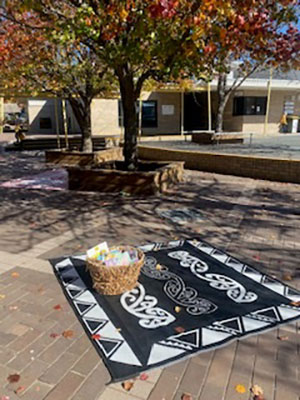
Book basket and mat in the courtyard to encourage reading for pleasure during lunch breaks.
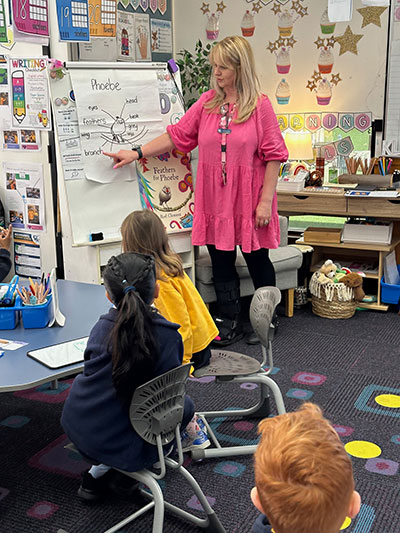
Teacher modelled writing mini lesson.
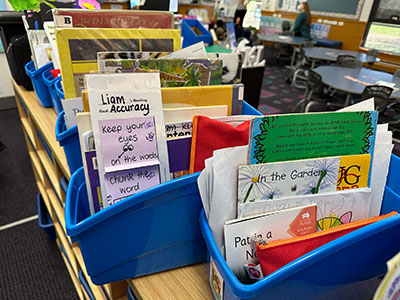
Kindergarten book boxes with student choice and teacher choice books
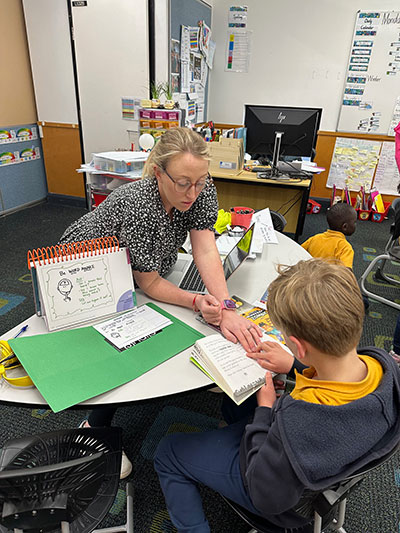
Teacher student 1:1 conference
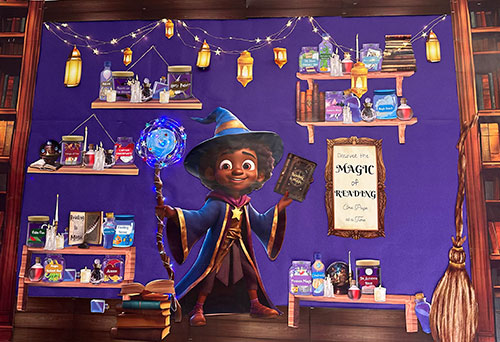
Engaging Resources in the School Library.
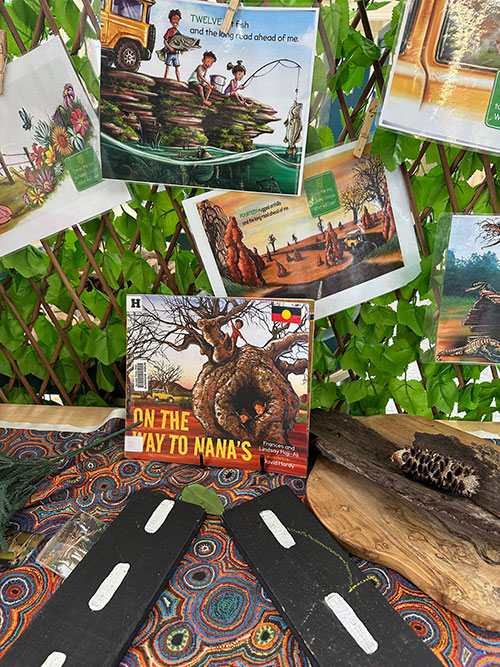
First Nations picture books in the Koori Preschool classroom
Ngunnawal School Library
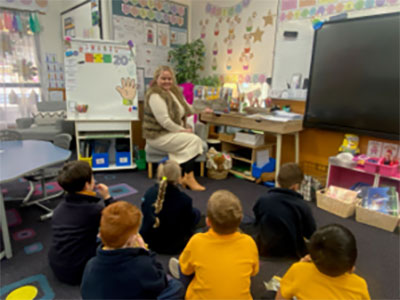
Teacher read aloud